

Engaging with the IRS becomes very difficult when one is under audit, in tax arrears, subject to penalties or collections, or has disputes regarding the tax return filed. In such cases, most people choose to have a qualified professional, such as experts at World Tax and Accounting, communicate with the IRS on their behalf. Form 2848 is one such form that is commonly used in this regard.
Under federal legislation, taxpayer information is treated with confidentiality. The IRS cannot disclose tax information to a third party without getting authorization from the taxpayer. The taxpayer can give authorization through the use of Form 2848. This form gives authority for the agent to represent the taxpayer and get tax information.
There are several reasons a taxpayer might choose to utilize the IRS Power of Attorney form, but mostly they tend to involve either a complex tax situation or an inability to communicate with the IRS directly. It should be noted the taxpayer does not need to cite any reason for designating an agent.
Understanding how this form works can be helpful for individuals and businesses.
What is Form 2848?
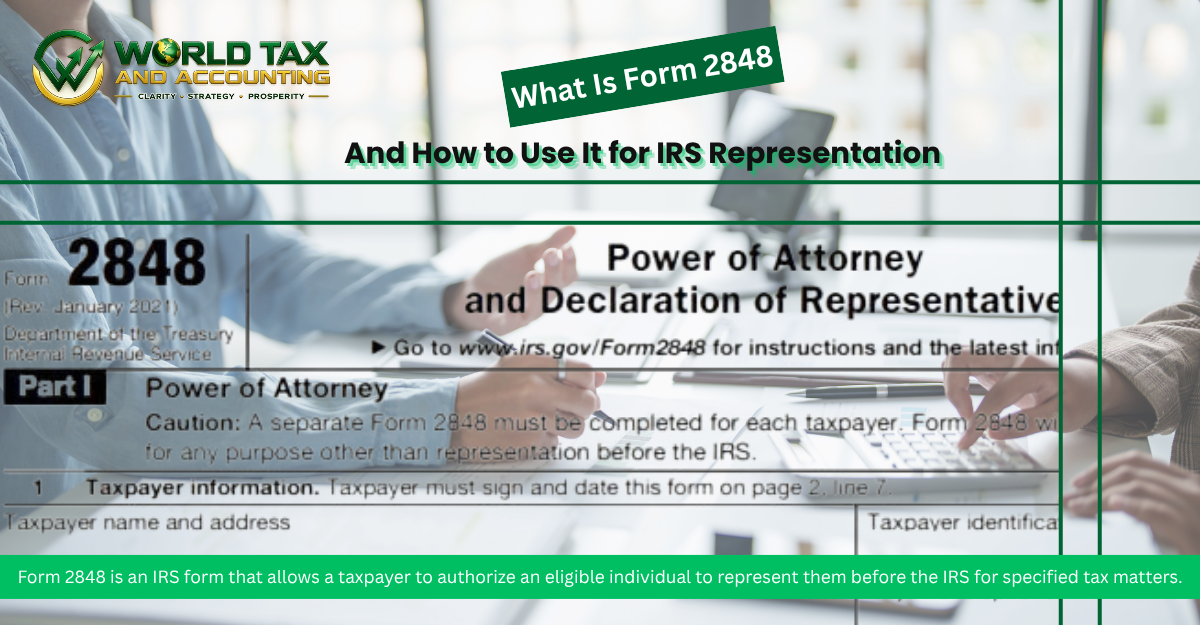
What is Form 2848? It is an IRS form that allows a taxpayer to authorize an eligible individual to represent them before the IRS for specified tax matters and tax years or periods. Actually, Form 2848 is a power of attorney for tax matters with the IRS, and a declaration of representative is a legal document that allows a taxpayer to authorize another individual to represent them before the IRS.
For matters regarding taxpayers’ taxes, this representative may communicate with the IRS, advocate for the taxpayer, and receive certain confidential tax information covered by the authorization.
The appointed individual must usually be someone who is qualified to appear before the IRS. People who qualify to appear before the IRS include certified public accountants (CPAs), and enrolled agents, but this list is not exclusive, and there are more individuals whom the IRS allows to practice before them. The form 2848 will help especially if the tax situation is complex.
When Should You Use IRS Form 2848?
Often, taxpayers have to consider IRS Form 2848 when they need professional assistance with IRS matters. These could be a tax dispute, collection issue, or other specified federal tax matter.
Some common situations are as follows:
- An IRS audit or examination
- A significant tax balance
- IRS collection notices
- Tax penalties or disputes
- Unfiled or incorrect returns
- Appeals of certain IRS decisions
- Other complex federal tax matters
What Information Is Included on Form 2848?
Completing the form correctly is important because each section serves a specific purpose, and the authorization only applies to the matters and periods specified. If you complete it carefully, this way, you can avoid delays in the form processing stage and prevent the form from being rejected.
1 – Taxpayer Information
Requires information from the taxpayer, such as name, address, Social Security number or ITIN, and, when applicable, EIN. Businesses must provide the appropriate entity information.
2 – Representative Information
The taxpayer provides details of the authorized person who acts as their representative on their behalf. Only an individual who is eligible to practice before the IRS may generally be appointed.
3 – Tax Matters and Tax Periods
The taxpayer must identify the particular issue, the relevant tax form number when applicable, and the tax year or period covered by the authorization. This detail defines the scope of the representative’s authority.
4 – Additional Authority
Also included on Form 2848 are sections describing additional acts that might be authorized as well as those that aren’t. Taxpayers need to review these provisions carefully to make sure that the authorization will match exactly with the tasks they wish to have performed by the representative.
5 – Prior Powers of Attorney
The form also explains how to handle prior powers of attorney, including whether or not to carry forward prior authorizations to be effective or revoke prior authorizations to be effective for the covered matters.
6 – Taxpayer Signature
The taxpayer must sign and date the authorization. When married taxpayers file jointly, they normally have to sign separate Forms 2848 if they both want their representative to represent them.
7 – Representative Declaration
The representative must also sign and complete the declaration identifying the professional designation under which he or she is authorized to practice before the IRS.
How to Submit Form 2848?
There are currently several ways you can submit a power of attorney to the IRS. Tax Pro Account is available for certain digital authorizations for qualified taxpayers and professionals. Depending on the circumstances and method being used, the IRS also accepts Forms 2848 by mail, fax, or online.
The specifics of how a person submits may differ depending on the type of taxpayer, the tax matter, the tax period, and whether prior authorization needs to be kept or canceled. Choosing the proper method may help prevent processing delays.
The Benefits of Professional IRS Representation
A professional IRS representation may prove to be particularly useful when dealing with IRS issues that involve more than one year of records, complex accounting data, or severe tax implications.
Some of the benefits of professional representation include the following:
1 – Professional communication: An authorized representative can communicate with the IRS regarding any tax issue which is covered by the authorization.
2 – Better organization: A tax professional can help gather and organize records and supporting documents.
3 – Reduced stress: Taxpayers may avoid handling every IRS communication themselves.
4 – Strategic guidance: A qualified professional can explain available procedures and potential resolution options.
5 – Audit support: IRS audit representation can help taxpayers respond appropriately during an examination.
6 – Resolution assistance: Representation can support taxpayers who are exploring eligible tax-resolution or collection options.
The IRS, in particular, acknowledges the taxpayer’s right to hire a chosen representative.
How World Tax and Accounting Can Help
Form 2848 is an important authorization to represent someone before the IRS. Filling it out carefully and authenticating it securely is crucial because it gives you access to confidential tax information and representation authority. This is especially true since in 2024 more than 1.9 million tax returns were suspended pending identity verification opened in a new tab.
World Tax and Accounting provides IRS representation services regarding IRS notifications, tax audits, tax dues, unfiled tax returns, collection issues, and other federal tax issues. If representation is needed, an experienced tax CPA or other qualified professionals may help with the authorization process and communications with the IRS, barring any limitations on eligibility or the scope of authorization.
World Tax and Accounting also provides broader tax services, including tax preparation, planning, accounting, and resolution support. This allows clients to address an immediate IRS problem while also working toward better tax compliance and future planning.
Contact us today for professional IRS representation, tax preparation, and support with eligible IRS tax relief and tax-resolution matters.