

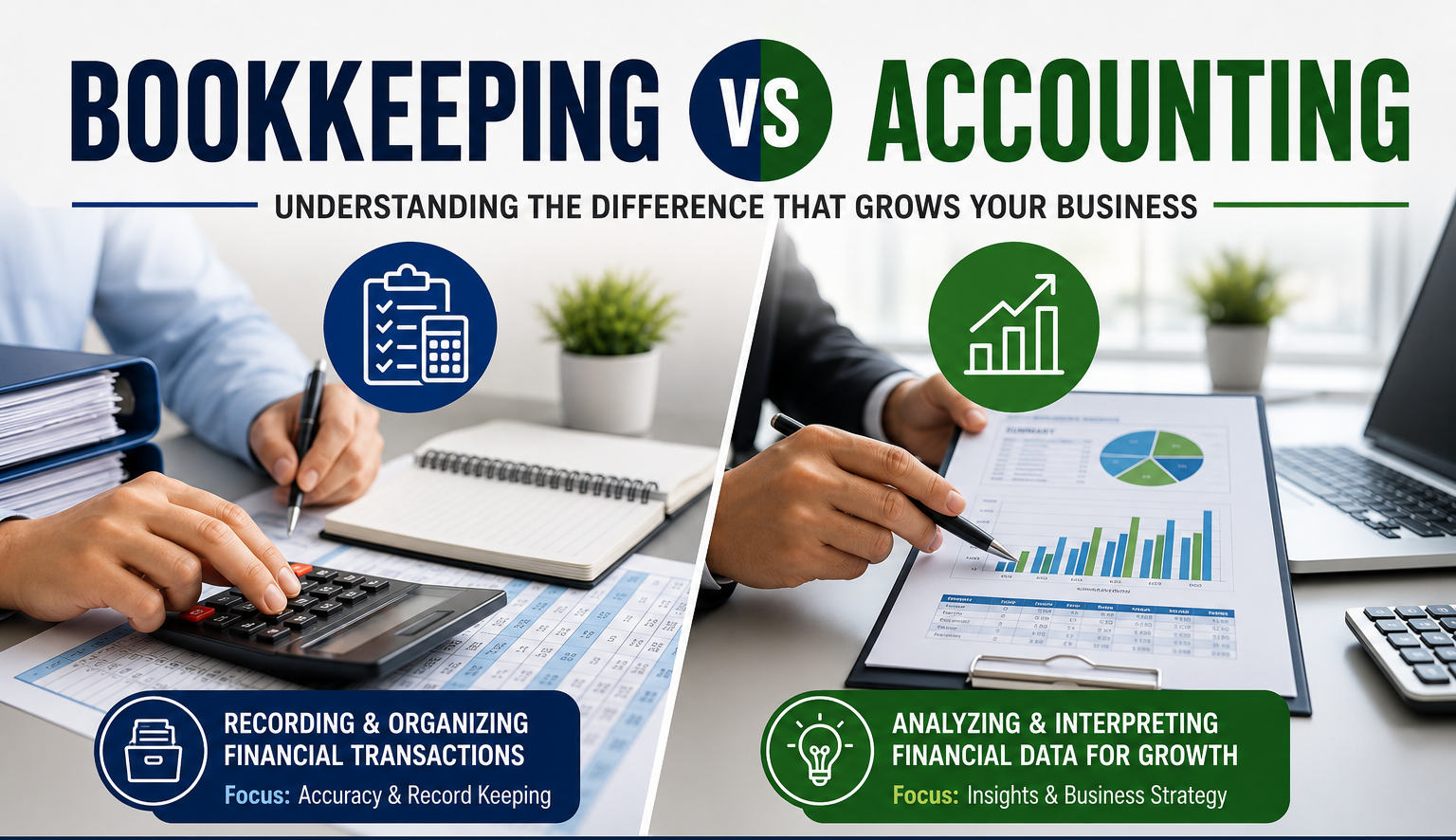
If you ask small business owners about bookkeeping vs. accounting and what the differences are in both, normally they reply, “Aren’t they the same thing?” They need to understand that both are not the same, and confusing the two is one of the most common and costly financial mistakes small business owners make.
Both bookkeeping and accounting services are necessary to the financial health of your business. They are used for completely different purposes, operate at different levels, and require different skill sets. However, it is important to understand how they work, separately and together. It is the first step toward building a financial foundation that supports real growth, keeps you IRS-compliant, and prevents the kind of year-end chaos that costs small business owners thousands in cleanup fees, missed deductions, and avoidable penalties.
What Is Bookkeeping, And What Does a Bookkeeper Actually Do?
Bookkeeping can be described as a practice that ensures everything is in order in relation to your finances. Bookkeeping for small businesses involves keeping proper records of all financial transactions made by the company.
Some of the areas covered by bookkeeping services for small business include:
- Recording daily income and expenses in your general ledger
- Reconciling bank and credit card accounts each month
- Managing accounts payable (what you owe vendors) and accounts receivable (what customers owe you)
- Processing and tracking invoices
- Running payroll entries
- Producing basic financial reports, such as profit and loss statements, balance sheets, and cash flow summaries
Bookkeeping is exact, transactional, and ongoing. There are no plans, analysis, or decisions made regarding your financial future. All the bookkeeper needs to do is make sure your figures are exact and up-to-date.
In cases when the professional bookkeeping service is performed properly, you will be aware of how much money you have spent, all your documents are prepared for tax season, and there are no unpleasant surprises in your account balance. In case of negligence in your bookkeeping, even for several months, the backlog increases very quickly. One month of unprocessed transactions will require three times more time to resolve.
What Is Accounting, And How Is It Different?
Bookkeeping describes the activities in your business. Meanwhile, accounting shows the meaning and explains what needs to be done about them. The work of accounting service firms is on another level, taking the clear and correct data that has been kept by the bookkeeper and turning it into useful information.
The basic accounting services for small businesses are as follows:
- Preparing and analyzing financial statements (income statements, balance sheets, cash flow statements)
- Identifying trends in revenue, expenses, and profit margins
- Developing tax strategy to minimize your annual liability
- Preparing and filing federal, state, and local tax returns
- Ensuring compliance with IRS regulations and tax law changes
- Financial forecasting and budgeting for future periods
- Advising on business structure (LLC, S-Corp, C-Corp) and its tax implications
- Supporting loan applications with compliant financial reporting
- Managing year-end closing procedures
The difference between bookkeeping and accounting is this. Bookkeeping is objective, retrospective, and looking backward. While the accounting is interpretive and prospective. The bookkeeper gives you what your numbers are. The accountant interprets these numbers for you, shows you how to do better, and helps you safeguard your interests in the future.
Why Small Businesses Make the Mistake of Choosing One Over the Other
Most of the small businesses start out doing their bookkeeping themselves at first, but as they progress, there will be more complicated things in terms of financial activities and taxes. It is not sufficient to only use a bookkeeper or just the tax preparer because it may result in overlooking valuable financial information, expensive mistakes, and increased costs for preparing taxes. The best way to do it is by using good bookkeeping in combination with accounting.
What Happens When Bookkeeping and Accounting Work Together?
Small businesses can benefit financially from a strong combination of accounting and bookkeeping services because bookkeeping and accounting services operate as an integrated system. Perfect data always feeds better decisions. Only a professional accountant can give you accurate tax planning and financial advice if the underlying records are accurate. Proper bookkeeping provides help to the accountant because of its accuracy; your accountant can spend their time on analysis rather than cleanup.
The gap between the two can be stressful during the tax season. When both functions work together, your returns are prepared from organized, verified records. Combined accounting and tax services with strong bookkeeping give you a monthly pulse check on your business’s true financial health, and applying them correctly reduces your tax liability.
A major advantage of a proper combination of bookkeeping and accounting services is that you are protected during an IRS audit. If the IRS ever questions your return, organized and complete financial records are your first line of defense.
When Does Your Small Business Need Both?
Although every business is unique, you should know when to invest in bookkeeping and accounting support. Let’s see the triggers
- When your annual revenue exceeds $100,000
- When you have hired your first employee or independent contractor
- When you are making quarterly estimated tax payments
- When you are applying for a business loan or line of credit
- When you spend more than five hours per week on financial record-keeping
- When You don’t have a clear picture of your monthly profit and loss
- When You are considering a change in business entity structure
If you are experiencing any of these stages, the cost of not having both functions in place exceeds the cost of getting them properly set up.
How World Tax and Accounting Helps Small Businesses Get Both Right
World Tax and Accounting understands that small business owners should be focused on growing their business; getting bogged down in financial records wastes their valuable time. If you don’t want to get bogged down in the numbers, get expert accounting and professional bookkeeping services from us. We provide fully integrated bookkeeping services for small businesses and accounting and tax services under one roof, so your books and your strategy are always aligned.
Here is what we bring to small business clients:
Monthly Bookkeeping: Our expert team manages your transaction recording, bank reconciliations, accounts payable and receivable, and payroll entries on an ongoing monthly basis.
Accounting and Tax Services: Our licensed CPAs take your bookkeeping data and build on it, preparing your federal and state tax returns, developing proactive tax strategy, identifying deductions you may be missing, and advising on structure, timing, and planning decisions
Seamless Integration: Your records and your strategy work together internally; there is no gap. Your accountant reviews your financials monthly, and our bookkeeping team adjusts in real time based on that guidance.
IRS Compliance & Audit Protection: Tax accounting services include all compliance oversight. We help you file accurately, make your estimated payments on time, and keep your records audit-ready at all times. If the IRS ever does come calling, we represent you directly and handle every aspect of the response.
Scalable Support as Your Business Grows: From a sole proprietor to a growing LLC, our services scale with your needs. We start with what your business requires today.
Ready to get your small business finances in order?
Your books are an important part of your business. As a business owner, you need both bookkeeping and accounting services to work together with them seamlessly.
Contact World Tax and Accounting today and learn how our integrated bookkeeping services for small business and accounting and tax service can give your business the financial clarity it deserves.